May 3, 2026
Paid or free audio guide? How to choose the right price
Paid or free audio guide? Pros, cons, real museum examples, a decision matrix and a break-even formula to help you set the right price for visitors.
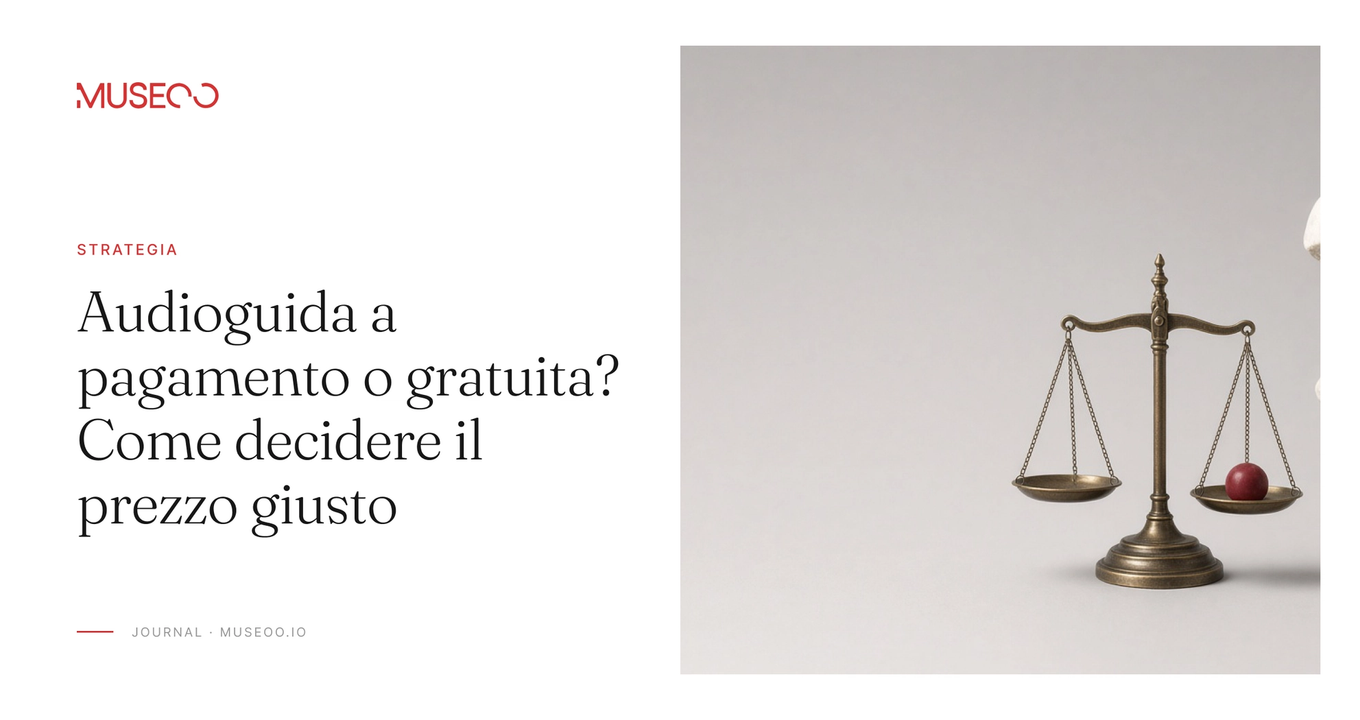
It depends on your goal: if what matters is that many people use the audio guide, free wins; if what matters is covering costs, charging can work, especially with many international visitors. Between the two there are also hybrid models.
At the Van Gogh Museum, the audio tour costs €3.75. A short walk away, the Rijksmuseum gives its audio tours away free in its app. Two of Amsterdam's best-known museums, two opposite choices. Neither is wrong.
If you are weighing up a paid or free audio guide, this article is for you. It is written for museum directors and visitor experience managers who want a reasoned answer, not a habit. You will find what the limited evidence says, the pros and cons of each option, hybrid models, a decision matrix and a break-even formula for setting a price.
This article is about what visitors pay. If you need to know what an audio guide costs the museum, see How much does an audio guide cost? 2026 pricing models compared.
Paid or free audio guide: start with your goal
Before you think about price, ask what your audio guide is for. There are two possible answers, and they pull in different directions.
- Mission: helping people understand the collection, welcoming international visitors, making the museum more accessible. Here, what matters is how many people use it.
- Revenue: covering the cost of the service or earning extra income. Here, what matters is how much you earn per visitor.
Most museums want both. But when you have to choose, one weighs more. Write it down. You will need it when someone in a meeting asks why you don't charge for it. Or why you do.
What the evidence says (not much, but it's clear)
There are no large sector-wide studies on price and usage. There are, however, a few well-documented cases from museums that measured.
- Take-up is low when visitors pay. British Museum researchers reported that its permanent-collection guide was used by around 3% of visitors, and that about 3% is standard across the sector for permanent-collection guides.
- Price is an explicit reason to say no. In one British Museum exhibition, 23% of visitors knew about the audio guide but decided not to take it because of the price. The authors added that £5 was already at the top of what visitors were willing to pay for an exhibition guide.
- Even a small fee makes a difference. The Brooklyn Museum lent out devices for two weeks. In the free week, visitors checked out 42. In the $5 week, just one.
- Making it free can change everything. At George Washington's Mount Vernon, the $7 audio tour had single-digit adoption. Once it was included with admission, alongside a ticket price increase, usage ramped up immediately.
These are individual cases, in contexts that may differ from yours. But they all point the same way: price reduces usage, and by a lot.
There is another side, too. In Italy, the Ministry of Culture's statistics office reports that in 2023 rented audio guides in state museums, monuments and archaeological sites took about €8.12 million gross, from more than 1.5 million receipts, with revenue up about 27% on 2022. At highly visited museums, plenty of people will pay.
When a free audio guide makes sense
Including the guide in the ticket, or offering it free to everyone, is the choice of museums that put mission first.
Pros
- Maximum usage: nothing stands between visitors and your content.
- No sales, codes or refunds to manage.
- One more reason to choose your museum, especially if it is small.
- Easier accessibility: people who need the guide don't have to ask or pay.
Cons
- No direct revenue to cover production and updates.
- The risk of taking for granted a service that has a real cost.
- With a public QR code, the guide is also accessible to people who never come in.
Examples. The Rijksmuseum app offers free audio tours, the same ones available for hire at the museum's multimedia desk, in ten languages plus Dutch Sign Language. Mount Vernon now includes its tour with general admission, including for school groups.
What these have in common: the free version runs on the visitor's own phone, or its cost is built into the ticket. Without devices to buy, charge and clean, giving the guide away costs far less.
When a paid audio guide makes sense
Charging for the guide makes sense when revenue matters and your audience is willing to pay.
Pros
- Income that can cover all or part of the cost of the service.
- Higher perceived value: people tend to value what they pay for.
- The ability to fund new languages or tours from the revenue.
Cons
- Fewer people use it, as the cases above show.
- You need a point of sale, a payment system and a way to stop one access being shared.
- The visitors who opt out on price are often the ones who would benefit most.
Examples. The Vatican Museums rent their audio guide for €8, with more than 400 commentaries in 12 languages. The Van Gogh Museum charges €3.75 for adults, rising to €4 from 1 January 2027, and lets visitors add it when they book their ticket. Both are destinations with large international audiences. That is where charging works best.
The third way: hybrid models
You don't have to choose between all free and all paid. Many museums combine the two.
- Free basics, paid depth. The British Museum offers 65 free gallery introductions in its app and sells the full guide for £6 per language, or individual themed tours from £1.99.
- Free on your phone, paid on a device. At the Rijksmuseum, the app tours are free, while the same tours are also available for hire at the multimedia desk.
- Free for some audiences. The Van Gogh Museum's audio tour is free for children up to 12 and €2 for ages 13 to 17. Schools, families, disabled visitors or local residents are all candidates for a free or reduced rate.
- Included in the ticket, with a small increase. This is the Mount Vernon approach: a guide for everyone and a slightly higher admission price. The cost is covered, usage is maximised.
- Free collection, paid exhibition. The permanent collection guide stays free. The temporary exhibition, with its more motivated audience, gets its own paid guide.
Step by step: how to decide
Use this matrix. For each row, mark which side your museum falls on.
- Main goal: Points towards free: Mission, accessibility, engagement; Points towards paid: Revenue, financial sustainability
- Annual visitors: Points towards free: Small to medium; Points towards paid: Large, with steady flows
- International visitors: Points towards free: Few; Points towards paid: Many, with language barriers
- Ticket price: Points towards free: Already high, or free entry; Points towards paid: Low compared with the value of the visit
- Labels and panels: Points towards free: Sparse or in one language only; Points towards paid: Rich and multilingual
- Variable cost per visitor: Points towards free: Close to zero (visitor's own phone); Points towards paid: High (devices, headphones, staff)
- Guide length: Points towards free: Short, a few minutes; Points towards paid: Long, with lots of content
- Governance: Points towards free: Rules limit fees and add-on services; Points towards paid: You are free to set prices
If most of your answers fall under "Points towards free", start free. If they fall under "Points towards paid", consider charging. If you are in the middle, a hybrid model is almost always the right answer.
How to set the right price
If you decide to charge, don't pick a number by gut feeling. Follow these steps.
Step 1: look at benchmarks
Published prices cluster in a fairly narrow band. The Van Gogh Museum charges €3.75. The Vatican Museums charge €8. In Milan, the city's tender for the Galleria d'Arte Moderna caps device rental at €5, headphones included. And Italy's 2023 state museum figures work out at about €5.35 per receipt (our calculation).
Step 2: compare it with your ticket
A guide that costs almost as much as admission feels expensive. Think about what it adds to the total cost of a visit, especially for a family.
Step 3: respect price thresholds
British Museum researchers saw £5 as the ceiling for an exhibition guide. It is a useful benchmark: beyond that threshold, willingness to pay drops.
Step 4: plan concessions
Children, schools, disabled visitors and carers should get a reduced rate or free access. It is a question of fairness, and often of policy too.
Step 5: show the value
British Museum visitors used the number of stops to judge whether a guide was worth the money. Put the number of stops, the minutes of audio and the languages on your sign.
Step 6: test and measure
Try a price for a few months, then change it and compare. With a digital platform, you can do that without reprinting anything.
The break-even calculation
To see whether charging really pays, compare both options with a simple formula:
Annual net revenue = visitors × take-up rate × (price − fees and costs per access) − annual fixed costs
Hypothetical example, just to show the maths: a museum with 40,000 visitors a year sells its guide at €4. Assume a 5% take-up rate and €1 of fees and costs per access. Revenue before fixed costs is 40,000 × 5% × €3 = €6,000. With €1,500 of annual fixed costs, net revenue is €4,500.
Now run it again with a free guide. Revenue is zero, but many more visitors may listen. The real question becomes: is that €4,500 worth the visitors who go without? There is no universal answer. There is yours.
Always use your own numbers. Take-up varies a lot from one museum to another, and it is the figure that moves the result most.
If you use Museoo
With Museoo, you decide guide by guide. A universal QR code makes a guide free for every visitor. A non-transferable QR code makes it paid: each code works for one visitor only. You can use both together, for example a free collection guide and a paid exhibition guide, and switch at any time. Our pricing page also includes a revenue simulator.
Common mistakes to avoid
- Deciding out of habit: "we've always charged" is not a reason.
- Setting a price without benchmarks: look at what similar museums do.
- Forgetting concessions: schools and families are often the audiences who benefit most.
- Selling a guide behind a public QR code: if the code can be photographed and shared, charging won't hold.
- Not promoting it: free or paid, a guide nobody notices goes unused. We explore this in The museum's engagement gap.
- Not measuring: without usage data, you will never know if your price is right.
Frequently asked questions
Is a paid or free audio guide better?
It depends on your goal. If reach matters most, free wins. If covering costs matters most, charging can work, especially with many international visitors.
How much should we charge for an audio guide?
The published prices we checked range from €3.75 at the Van Gogh Museum to €8 at the Vatican Museums. For a guide on the visitor's own phone, a lower price reduces drop-off.
Does a free audio guide lose the museum money?
Not necessarily. With a smartphone guide, the cost per visitor is low. It can also be covered by a small increase in the admission price, as Mount Vernon did.
Can you charge for a smartphone audio guide?
Yes, but you need access that can't be shared, such as a code or a QR code valid for one visitor only. A public QR code can be photographed and used by anyone.
Can we change our minds after launch?
Yes, and you should be ready to. Try one model for a few months, measure usage and revenue, then decide whether to keep it.
Download the "Free or paid?" spreadsheet
We have built a ready-to-use template you can fill in with your museum's data:
- the decision matrix from this article, with automatic scoring
- a break-even calculator comparing free, paid and hybrid guides
- a pricing checklist covering concessions, communication and the metrics to track
Leave your email and get it straight away.
Would you rather work through your numbers with us? Book a demo.
Free resource
Free checklist: launch your museum's audio guide in 6 steps
A checklist to print and fill in with your team: every step from the route to your first statistics, timings for each phase, common mistakes and price benchmarks. 8-page PDF, free.
Newsletter
Stay close to the
future of museums.
Essays, observations, and research on storytelling, experience design, and the digital evolution of cultural institutions. No noise.