June 2, 2026
Museum visitor engagement: gamification, quizzes and family trails
Museum visitor engagement with light gamification, quizzes, missions and family trails. A practical how-to with a printable template.
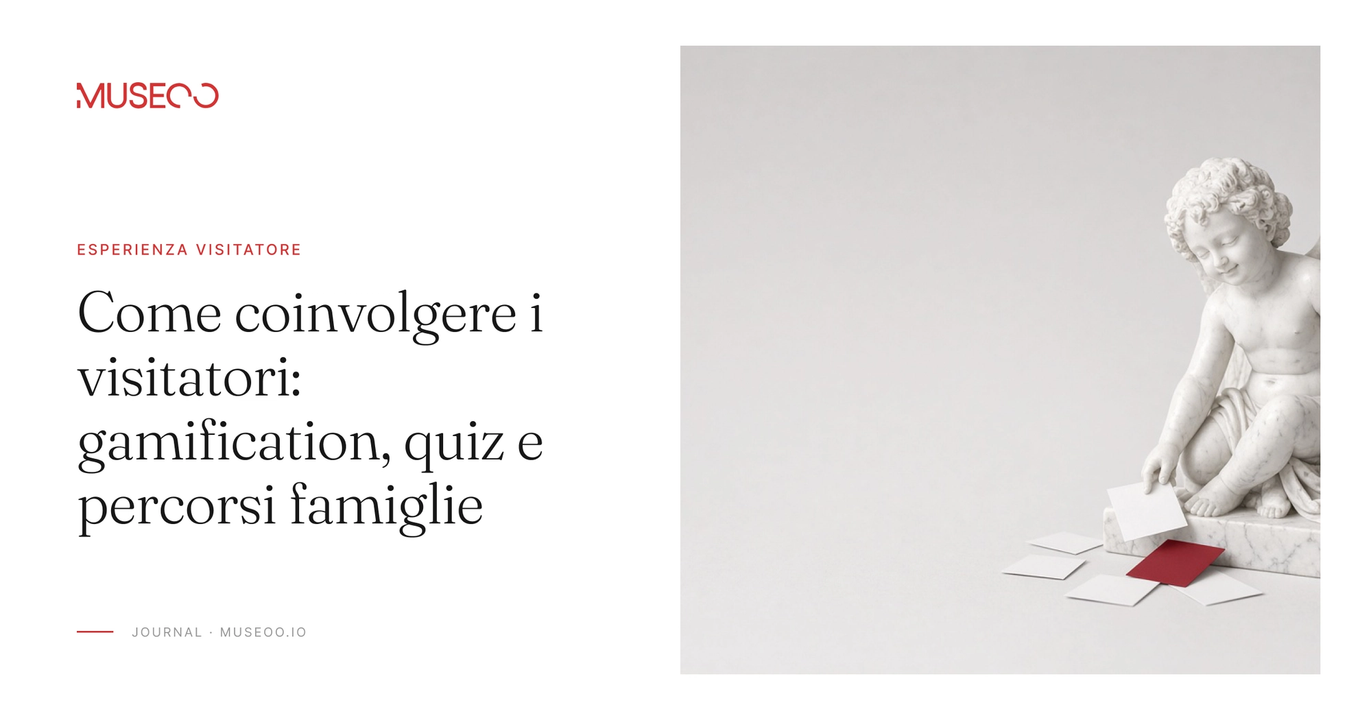
To engage museum visitors, give them an active role: look in order to find, answer, choose, collaborate. Light gamification, quizzes, missions and family trails work when they keep the object at the centre and are tested before launch.
The galleries are busy. People photograph the first room, speed through the second, leave after the third. That is not always disinterest. Often it is the lack of a concrete reason to stop, choose and respond.
This guide is about museum visitor engagement in practical terms: light gamification, quizzes, missions, badges and family trails. It is written for directors, learning teams and visitor-experience leads in small and mid-sized museums. It is not another essay on the engagement gap, and it is not our reflection on engagement versus attention. Those pieces set the problem. This one builds activities you can launch in a few weeks.
What we mean by engagement (and what we do not)
Engagement is not “more screens”. It is giving visitors an active role: look in order to find, pick a route, answer a question, collaborate with whoever came with them.
In research, gamification is often defined as the use of game design elements in non-game contexts. A 2024 study in Humanities and Social Sciences Communications (Nature Portfolio) wove goals, stories and role-play into a museum visit. The clearest effects showed up in non-cognitive outcomes: closer attention to detail, more admiration for the craftspeople on display, and fewer age stereotypes. It did not claim miracle test scores. It showed that a well-shaped activity changes how people look.
Other museum studies on mobile serious games and situated tangible gamification make a point small museums can use tomorrow: challenges should pull the eye toward the object, not toward the phone.
Golden rule: if visitors remember the game but not the object, the design failed.
Before you invent a game: three questions
- Who do you want to engage? Families with children aged 6–10, teenagers, curious adults, school groups.
- What should remain after the visit? A fact, a feeling, a link between rooms, a reason to return.
- How much time do they have? 30, 60 or 90 minutes.
Without answers, every quiz becomes noise.
Ingredients that work in smaller museums
You do not need dozens of game mechanics. A few clear levers are enough.
1. A concrete goal
“Find five key works” beats “explore the collection freely”. A goal shapes the visit without sealing it shut.
2. A light story
A thin narrative thread (“you are an investigator”, “rebuild the artist’s journey”, “help the workshop catalogue objects”) supports motivation, as in the Nature study above. Keep the story short and respectful of the collection.
3. Contextual quizzes
Questions tied to what is visible here, not to encyclopaedia trivia.
Good examples:
- “How many animals can you spot in this painting?”
- “What material does the frame seem to be made of? Look closely.”
- “Which object would you use every day if you lived in this period?”
Avoid:
- “In which year was the artist born?” (if the date is not in the room)
- Trick questions that punish visitors for not knowing
4. Missions and detail hunts
Short tasks: find, compare, choose, sketch, photograph a detail (where allowed), listen and point.
5. Badges and collectibles (in moderation)
A digital badge or a paper stamp can close a mission well. Skip aggressive leaderboards between families. In museums, personal or small-group progress (“you completed 4 of 5 missions”) usually beats stranger-versus-stranger scoring.
6. Immediate feedback
A correct answer, an extra hint, a curator line that unlocks: feedback keeps attention alive. Research on a casual museum game (Ask Dr. Discovery) shows how a simple interaction can support engagement with content when it stays tied to exhibits.
Family trails: the best format to start with
If you can run only one project, start with families. They ask for activities, they return, and they talk about the museum afterwards.
Typical structure (45–60 minutes)
- Welcome (2 minutes): how it works, how long it takes, where to start.
- 5–7 stops along the natural visit route.
- One mission per stop (observe, choose, answer).
- One collaborative moment (adult and child decide together).
- Closing: what you discovered + a soft next step (exhibition, workshop, shop).
Design principles for families
- Child track written for ages 6–10; adults get optional depth.
- No stressful timers.
- At least one seated stop.
- Space for two people in front of the work without blocking traffic.
- A fallback if a stop is crowded (“if there is a queue, jump to stop 4 and come back”).
Sample stop (template)
Stop 3 — The still life
- Look at the table. How many objects can you count?
- Which one would you take home today, and why?
- Bonus: find a detail most people miss. Tell the person next to you.
Suggested time: 3–5 minutes. Then an arrow to the next room.
How to build quizzes that teach (not examine)
Use this four-step recipe.
- Pick a learning goal (e.g. “tell a portrait from a genre scene”).
- Anchor the question in a visible detail.
- Offer 2–3 options (better than endless true/false).
- After the answer, give the why in one sentence.
Before / after:
- Before: “Who painted this work?”
- After: “Look at the figure’s hands. Do they look like a worker’s or an aristocrat’s? What makes you say that?”
The second question starts a conversation. The first starts exam anxiety.
Gamification without an app (paper and QR)
You do not need a complex platform to begin.
Minimum paper kit
- One A4 folded booklet.
- A numbered map.
- Stickers or stamps at the desk.
- Pencils.
Minimum light digital kit
- The same missions on a web page or as “mission” tracks in an audio guide.
- QR codes beside the works.
- Answers and micro-feedback in the same flow.
If you already run an audio guide, missions can live as a “families” layer on the same route. For content production, keep our guides on how to create a museum audio guide and how to write the script nearby.
A four-week plan
Week 1 — Goals and map
- Define audience and duration.
- Choose 5–7 works/stops.
- Write one goal sentence per stop.
Week 2 — Write missions and quizzes
- One primary mission + one bonus per stop.
- Review with a museum educator and one external parent.
Week 3 — Prototype
- Print 20 copies or publish a web draft.
- Test with three friendly families. Time them. Watch where they stall.
Week 4 — Soft launch
- Desk sign: “Family trail: 45 minutes”.
- Train staff on one invitation sentence.
- Collect 10 written comments. Fix the two weakest stops.
Template: family trail / quiz (copy and adapt)
Use this card for every stop.
Stop no. __ | Work / space title: __________
Estimated time: __ minutes
Goal (1 sentence): __________

Main mission (for children):
__________

Question / quiz (max 3 options):
A) __
B) __
C) __

Feedback after the answer (1–2 sentences):
__________

Bonus mission (optional):
__________

Wayfinding to the next stop:
__________

Staff note (crowding / alternatives):
__________
The downloadable resource at the end of this article packages this template (cover, short rules, stop sheets, printable badges).
When a digital tool makes sense
Paper and pencil are enough to start. Digital helps when you need:
- more languages without reprinting;
- quizzes that adapt by room;
- badges without paper;
- data on which missions get abandoned;
- a stop update in one afternoon.
If you use an audio-guide platform with engagement features, keep them discreet and in service of the trail. Typical useful levers — missions such as “find 5 key works”, contextual quizzes, badges tied to points of interest, real-time micro-feedback, family itineraries — should feel like mediation tools, not the main show. Museoo, for example, builds these into the visit; the brand is secondary. Keeping game and collection together is the point.
Keep the game from stealing the object
The most common risk in art and history museums is designing an activity so lively that it becomes the main memory. Visitors leave happy about the quiz and vague about the work.
Three checks before launch:
- Gaze time. In testing, count how many seconds people spend on the object versus the sheet or screen. If the sheet wins, cut text and options.
- The closing line. Every stop should leave a sentence about the work, not about the score.
- Useful silence. Leave 20–30 seconds with no mission in front of one masterpiece. Engagement includes time to stay without doing anything.
This is the same balance we ask of an audio guide: a voice that helps you see, not a voice that replaces looking. If you build both layers (narration + missions), write them together so tone and length stay coherent.
Schools and groups: adapt without rewriting everything
A family trail adapts for school groups with a few changes:
- Cut to 4–5 stops if the slot is short.
- Assign roles in the group (observer, speaker, map-keeper).
- Prepare a teacher sheet with goals and answers.
- Avoid class leaderboards: prefer a shared goal (“complete every mission as museum-for-a-day”).
For adult groups (associations, corporate visits, tour operators), short team observation quizzes work better — no mascots, no child language. Same structure, different tone.
Common mistakes
- Gamification that competes with the object. Lights, sounds and scores that steal the gaze.
- Too many missions. Past 7–8 stops, many families quit.
- Oral-exam quizzes. If the answer needs a date that is not on display, rewrite the question.
- Children only, adults sidelined. Give adults a role (referee, co-investigator, optional depth).
- No field test. Real visitors always reveal one ambiguous arrow.
- Confusing attention with engagement. Holding someone in front of a screen is not the same as helping them understand the object (see engagement versus attention).
Frequently asked questions
Does gamification fit “serious” art museums?
Yes, if it is respectful. Observation missions and open questions beat mascots and noisy scoring. The tone should sound like your museum, not an arcade.
Paper or app?
Start on paper. Move digital when you need languages, frequent updates or analytics. Many museums keep both: a desk booklet plus a QR for phone users.
How many families do we need for a useful test?
Three to five test visits are enough to find the main friction points. A few observed tests beat a blind launch.
How do we know it works?
Simple indicators: finished booklets / digital starts, the stop where people drop off, desk comments, average dwell time on trail days, requests to do it again.
Do badges cheapen the visit?
Only if they are disconnected from looking. A recognition tied to a real observation strengthens the trail. Point-collecting for its own sake weakens it.
Wrapping up
Museum visitor engagement improves when you give people something concrete to do with the collection: look harder, answer, collaborate, choose. Gamification, quizzes and family trails are not marketing tricks. They are mediation tools. Use them lightly, test them, and keep the golden rule: the object stays at the centre.
For the wider problem of expectations and design, revisit the engagement gap and engagement versus attention. Then come back here and write your first mission.
Download the family trail / quiz template
If you want to see how missions, quizzes and family itineraries can live inside a smartphone audio guide, you can also book a demo.
Free resource
Free checklist: launch your museum's audio guide in 6 steps
A checklist to print and fill in with your team: every step from the route to your first statistics, timings for each phase, common mistakes and price benchmarks. 8-page PDF, free.
Newsletter
Stay close to the
future of museums.
Essays, observations, and research on storytelling, experience design, and the digital evolution of cultural institutions. No noise.